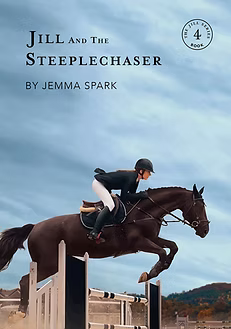
Book 4 – Jill and the Steeplechaser
synopsis
Jill Crewe is a young woman living in rural England during the early 1960s. In previous books her charmed childhood in Chatton with her two ponies Black Boy and Rapide, was described. In her spare time she wrote pony books about her real life. Teetering on the edge of adulthood she moved to the Scottish Highlands to live in a castle when her mother married Richard Micheldever. Moving on from ponies to horses she is now the owner of Balius, a magnificent thoroughbred cross Highland gelding, and a sweet chestnut mare, Copperplate. This is the fourth book in Jemma Spark’s Jill series and our heroine goes back to Chatton to live in her original home, Pool Cottage. Her best friend Ann Derry is emotionally wrecked from a love affair gone wrong and goes to stay with her. Their
life of horsey adventures, and sometimes misadventures continue. Jill acquires a steeplechaser and enters a point-to-point to try race riding. In order to qualify to enter the race Jill has to foxhunt and after her first enthusiasm she is forced to grapple with a moral dilemma when faced with anti-blood sport protests. A host of original characters parade through the pages including the Cholly-Sawcutt sisters, Jill’s old enemy Susan Pyke, Wendy Mead the instructor at Mrs Darcy’s riding school, James and Diana Bush, Jill’s cousin Cecilia and many more.
Chapter One – Back to Pool Cottage
Throughout the Scottish summer, I had been scurrying from one end of Blainstock Castle to the other, attending to the needs of our paying guests who came here for the grouse shooting. If you have missed the preceding three books, I do live in a Highland castle, where Mummy and I moved when she married Richard Micheldever more than a year ago. It was utterly perfect with just one blot on the horizon, Malevolent Mark Lansdowne, who is Richard’s nephew and who had taken an intense dislike to my mother and myself before we had even arrived. I had overheard him making scurrilous remarks about my mother and how she was a gold-digger. For this, I have never forgiven him. He is a pretentious up-and-coming three-day eventer and looks down his thin, slightly hooked aristocratic nose at us.
I have recently had a few qualms about the fact that Richard supplements his income through the shooting of the plump grouse, that live on the moor. During August and early September Richard hosts shooting parties and Mummy and I attend to visitors who come to stay in the castle. I don’t mind mucking in and helping – looking after the guests – but increasingly I stay away from the moors while the shooting is going on. When I ride my horses, I go the other way, so the pop, pop of the guns does not wring my soul in anguish with visions of dead, bleeding birds, and I politely decline the various dishes of cooked grouse at dinner.
This summer I haven’t had much time for riding. Mummy is pregnant and spends a lot of time sitting with her feet up, snoozing. She can’t help it, she is almost forty years old, and this pregnancy is pulling her down.
The days begin with the sound of bagpipes, which summon us from our beds to a sumptuous breakfast. Then the guests sally forth to the Highland moors where the sun blazes down on the rioting golden gorse and purple ling, and it is possible to get drunk on the heady scent of wildflowers. The days are very long and the nights very short.
Mummy, Richard and I dress for dinner. Mummy wears long, elegant, silk dresses with a rather dashing tartan sash that matches Richard’s kilt. She has insisted that I must wear something approaching evening wear and taken me to a local dressmaker, who is an excellent pattern cutter and can copy any design out of a magazine. It is the early 1960s, and the fashion is for shorter hemlines, but at the castle, we are still living in an elegant old world that demands dressing for dinner in the traditional style of floor-length gowns.
Every evening we would assemble in the courtyard and drink from elegant glasses as ragged rooks circle above the black shadows thrown by the
majestic dark walls, which tower over us. The gong would be rung, and we would process into the dining-room, which features an array of animals’ heads with glassy eyes staring superciliously down at us. The meal is a long-drawn-out affair of five courses, including the grouse cooked in various ways. Richard would fortify himself with several glasses of red wine to act the part of a genial host, entertaining the guests with tales of life at the castle in his parents’ days when the place had buzzed with life, the acme of fashion and elegance.
His favourite story was that his father as a baby would be swaddled in ermine tails and placed in a small dogcart pulled by a Shetland pony. He would be hauled to the shores of the loch and sat upon a tartan blanket to benefit from the bracing moorland air.
I was rather enthralled with Richard’s stories of the olden days and listened attentively. It was like something out of a book, and I relished it, as even up here in the depths of Scotland we could hear the bells of change clanging. It is the beginning of an era when freedom is a byword and tradition is anathema. I wasn’t sure that I liked it, any more than I liked the idea of leaving my carefree youth behind me and embracing adulthood.
All summer I rushed from bedrooms to the kitchen to the dining room, and back again, I didn’t have time to think about the approaching autumn when the crew would arrive to film Macbeth and I was to be the assistant to the Master of Horse. It was the most exciting thing that was ever to happen to me, and only at night, in the minutes before I fell into a dreamless sleep, I imagined the glamorous adventures that would befall me.
Now, don’t imagine dear readers, that I was deluding myself that I was about to be ‘discovered’ and had secret hopes of becoming a Hollywood star. Not at all! If you have read my last book, Jill Goes Pony Trekking, you would know that I had met a real movie star, without even recognising him and through this contact it had been arranged that a film version of Macbeth was to be filmed at Blainstock Castle and I was to have a job helping with the horses.
Eventually, the shooting season drew to a close and we stood at the entrance of the castle and waved off the last guest. We heaved a collective sigh of relief and Mummy went in to lie down. Her pregnancy bump was now beginning to show, and, finally, we had the castle back to ourselves, ready to prepare for the arrival of the actors and the film crew when Richard was called to the phone during breakfast. He returned, looking rather solemn.
“What is it, dear?” asked Mummy, who was patting her belly as if it were a favourite pet.
“Well Catherine my darling, they’ve postponed the shooting of the film until next spring, something to do with the finance and the schedule of the star
who is to play Macbeth. Anyway, they’re prepared to send me a cheque to make up for the disruption and asked that the contracts be redone so it will all begin in April or May next year. Of course, I’ve agreed although it won’t be terribly convenient as that is the time that the baby is due, but I suppose we’ll be able to muddle through.” He smiled ruefully at Mummy.
“Oh, no!” I wailed. This was a severe blow. Now the whole winter lay before me as a bleak icy-cold desert with nothing to do. I suspect that the desert simile is something of an oxymoron, but that is exactly how it felt, and perhaps one could argue that deserts get very cold at night – or so I am told.
Well, there was the rub, as they say in plays. I was fairly certain that Copperplate was in foal to a big golden stallion with whom she had been secretly cavorting in a field in the middle of last summer. This meant that she was due to foal in June next year. It would put her out of action in terms of competing for some time.
That left Balius, my big grey gelding, who had been coming along splendidly. But I couldn’t spend all day everyday training Balius, and it did look like a long lonely winter at the castle. I had to find myself some other adventure, although I couldn’t think of anything quite as exciting as working on a film shoot.
I was considering various possibilities and wishing that perhaps my new friends, the Heywards, from Australia might write and invite me Down Under for a second summer in the blistering heat, showjumping around the dusty show circuit. However, it is a mistake to try and steer one’s destiny as I have found that it leaps upon one when one’s back is turned, and usually in quite the opposite direction to that planned.
I went out to the stables and surreptitiously ran my hand down Copperplate’s belly. It was impossible to tell if she were in foal. If I called the vet and asked for an examination, it would be all over the district within hours as these Highland people do like to natter away and they find every detail about everyone else’s life to be fascinating. The last person I wanted to know that Copperplate was in foal was Mark. It had been a stallion that he was training that had ‘done the deed’ – so to speak – and I was unsure of the legality of the situation, whether perhaps the owner might demand a stud fee. So, I thought it best to keep it all hugger-mugger.
I decided to train Balius in the indoor arena this morning as the weather was grey and cloudy and rain was threatening. I dragged out the poles. John, who works as a groom, came over and helped me with the wings. We constructed two jumps, nothing complicated or difficult, but I wanted to give Balius training at the most basic of skills, getting the striding right between the jumps.
We did some circle work, and I noticed that Mark had arranged for two very large mirrors to be set up at the end of the arena. Although I wanted to write this off as an example of Mark’s narcissistic tendencies, I had to admit that it was incredibly useful for checking one’s riding position. I noticed that I was starting to lean forward a little too much. This would bring my balance forward and particularly when approaching jumps. It would mean that my weight was over the forehand just at the moment that Balius needed to lift himself into the air. I pulled my shoulders back and tried to sit bolt upright. Watching oneself riding in a mirror is an uncanny experience.
Balius was very clever, and he knew that as soon as I shortened my stirrups, it meant that we were going to jump, an activity which he absolutely adored. He began to dance sideways. He cantered around the arena his tail stretched out like a banner, his neat pointed ears pricked. He jumped over the fences in perfect parabolic leaps.
“He’s a good ‘un,” said John, watching us. “He’s ganna be good for you! Should I put the pole up, give him something to think’on about.”
“That is very kind of you,” I said to John, I still hadn’t got used to having staff at my beck and call, and I made every effort not to get hoity-toity. “Perhaps another peg.”
The jumps were higher now and with a longer stride between them. But Balius had settled well and was still listening to me and thinking about what he was doing. Twice we jumped perfectly, and each time I gave him a leg aid that told him that we needed a longer stride, and he got it exactly right. I leapt off and gave him a big pat and found a piece of apple in my pocket, which he accepted graciously from my outstretched hand.
“You’re the best horse in the world,” I told him. He nodded his head up and down as if he totally agreed with me. I had been honing my skills in communicating with horses and ponies for many years. I now felt that Balius and I had established a good rapport. Riding always cheers me up, and I took him back to the stable yard and rubbed him down, rugged him and let him out in the field with Copperplate. She was looking rather smug this morning as if she had a secret, and I was the only one who knew that she just might be in foal.
“Letter for me,” trilled Mummy when I strode into the library to have a cup of tea poured from the rather elegant art-deco teapot that was one of her prize possessions. She had inherited it from her mother, who had attended the big exhibition in Paris in 1925. I hope dear readers, that you will note this rather interesting piece of historical information, just in case you think I’m mouldering away in the Highlands and eating haggis with my fingers, I was doing my best to become just a little more cultured.
“The tenants at Pool Cottage have had to leave, they’ve gone, and the cottage is vacant, I’m going to have to do something,” said Mummy, a crease between her eyebrows. Then it came to me. This was the adventure I had been hoping for.
“I’ll go down to Chatton if you like, I can do some whitewashing and painting and fix the garden up and find some more tenants for you,” I said excitedly.
“Would you do that for me?” asked Mummy. “Jill, you are a dear, I couldn’t ask for a better daughter.”
I grimaced a little at this. Mummy was laying it on a bit thick, probably thinking that I was going to feel displaced by a tiny baby, but that wasn’t the case at all.
“When could you leave?” she asked
“Well, tomorrow I guess,” I said, thinking that this was a perfect opportunity to get Copperplate away, and Chatton in the winter would be considerably warmer than the Highlands. Scotland was wonderful in the summer but rather freezing and gloomy throughout the winter.
I had the luxury of choice as far as transport went, either the Land Rover and two-horse trailer or the horse box. I decided on the trailer as that would mean I would have the Land Rover to drive around when I got there. I didn’t fancy having to travel into Rychester in a truck just to do some shopping.
The next morning, I was ready to leave and suddenly worried that I should be staying to look after Mummy, but she assured me she was planning on sitting in front of the fire, tucked up in a tartan rug with a typewriter on her lap, tapping out something entirely new – her first adult novel! She was enthralled with this project and told me that she felt able to relax, knowing that I was going to sort out the situation at Pool Cottage.
The drive down to Chatton was uneventful, and I was filled with happy anticipation. I loved the castle and my new life in Scotland, but it felt good to be going home, where I was the real Jill Crewe, where everyone had known me for years.
I won’t describe the long, tedious drive, with frequent stops to water the horses and fortify myself with food from the hamper packed by Cook. Finally, I drove into the driveway of Pool Cottage, and a wave of nostalgia engulfed me. My whole happy childhood swept through my mind, and tears sprang into my eyes. Who would have thought that childhood memories would affect one so much? The cottage looked just as it always had, and a rush of affection for it filled my heart. The tenants didn’t appear
to have destroyed it. The field was shaggy with overgrown grass and the hedges thick and untrimmed, but this was good. Copperplate could be hidden away from prying eyes.
I lowered the ramp of the trailer and the horses backed out calmly. They looked around with interest and curiosity. I let them go in the small field, and they were happy to wander off through the orchard down to the area, where I used to do my schooling.
I let myself into the cottage and saw with relief that the few pieces of furniture that we had left behind was still there. I don’t suppose they would have been worth stealing, but again I felt this ridiculous wave of sentiment for the armchairs that sat on each side of the fire and the old wooden table and chairs upon which I had done my prep every night.
The kitchen cupboards were bare, so I decided to walk down to the village for some essentials. Mrs Buzzby in the shop was surprised to see me. Immediately she began to pump me for information that she could disseminate to everyone in the village. I told her that Mummy was pregnant and she nearly fell over herself in surprise, and I imagined that she would feverishly spread the glad tidings. I purchased a packet of tea, sugar, milk, bread, butter, cheese, tomatoes, a jar of jam and eggs. It was going to be strange to be fending for myself and not sitting down to sumptuous meals in a grand dining-room.
I decided to take a detour on the way home and call in at the Derry’s house, hoping that there might be some news of my best friend, Ann. I was amazed when she opened the door to me.
“Oh, brill!” I exclaimed. “Ann, you’re home, and so am I, living at Pool Cottage for a while, to set it to rights.”
Mrs Derry appeared behind her, her usual fussy and demanding self.
“Well don’t leave Jill standing on the doorstep, do come in dear, so nice to see you.” She smiled at me brightly, but without warmth, pecking her head up and down like a robin looking for crumbs, her hair perfectly coiffed, her nails manicured and painted a particularly anaemic shade of coral. I was bustled inside and sat down in the living room, as usual spotlessly clean with every ugly ornament polished meticulously.
“What’s wrong, Ann-Marie?” I asked as soon as her mother left us alone, hoping I hadn’t offended her by falling back on the old ways, calling her simply Ann when about a year ago she had metamorphosed into Ann-Marie, the social butterfly, playing at being a debutante.
“I’m not Ann-Marie any longer,” she burst out, and I noticed that her hair had been shorn and it was a curly cap of bright red, which was her natural
colour. All that careful styling of coloured brown hair was gone. “I’m just Ann now, Ann Derry, and I’m not playing stupid games anymore!”
“Keep your hair on,” I said jokingly. “Of course, you’re Ann – that’s what you’ve always been. Dare I ask what has made you change your mind?” I asked tentatively. I never felt entirely confident these days that Ann and I were on the same wavelength. I looked at her carefully. It was not only the new hairstyle. She looked pale and wan and her eyes, which were usually a sparkling deep-blue colour, were red-rimmed as if she had been weeping.
“What on earth has happened?” I asked aghast. Shame-faced that I had been so full of my news and wanting to confide in her about Copperplate’s possible pregnancy – I hadn’t been paying attention.
“I can’t tell you just straight out. It’s too upsetting. Oh, Jill, I’ve been such a fool,” she replied in a downcast and dejected way. She sat there in glum silence and looked away out the window as if viewing some ghastly spectacle. I was pretty shaken up. Ann had always been the most robust of people, jolly, determined and spirited. Now it was as if she had been deflated – a sad crumpled shell of her former self. I was almost afraid to find out what had happened, something too awful to contemplate.
Mrs Derry popped her head around the door and asked if I wanted some tea. Ann’s mother had a knack for making situations extremely awkward.
“Come home with me, I want you to help me with the horses,” I said to Ann, grabbing her hand, determined that I would physically drag her down the road if I had to.
“I can’t bear it!” wailed Ann in a heart-rending voice as we set off along the road and she collapsed in a heap on the grass verge. I was utterly dumbfounded. This sort of emotional display from Ann was just not in my realm of experience. I had no idea what to do. The most obvious thing was that she was suffering from a disastrous love affair, and as my own life had veered nowhere near romance, I didn’t know how one should commiserate. I had been longing to tell her about Copperplate’s possible pregnancy – but then it struck me – what if Ann herself was pregnant? There had been one girl in our form at school who had had to leave before her exams as she was ‘in the family way’, but her parents had rallied behind her, and the hapless youth had participated in a shotgun wedding. As far as we knew they were living if not happily ever after, at least tolerably contentedly. But things like that would just not happen to the likes of myself and Ann: we were robust, sensible and practical – or were we?
My mind darted from here to there, thoughts tumbling like rats in a trap. What else could have gone wrong? It was something to do with Ann personally, not like the Derrys losing all their money or a death in the family.
I pulled her to her feet and bustled her along, struggling with my shopping bags and propelling her forward. Finally, we got back to Pool Cottage. I guided her towards one of our comfortable old armchairs, and again she collapsed. I went into the kitchen to make tea and brought it back.
“We’re going to sit here until you tell me what is wrong. This is absolute torture! I am imagining the worst possible scenarios,” I said to her.
Ann sniffed several times, but gathering her strength, she launched herself into a tale of woe.