Book 2 – Jill Has Two Horses
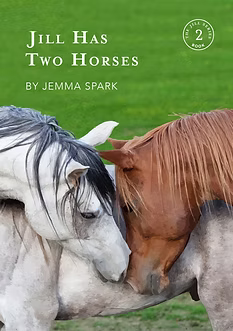
synopsis
Jill Crewe has left Chatton and is now living in a Scottish Highland castle with her mother and new step-father. She has a beautiful young grey horse, Balius, but she yearns for an older, trained mount so she can compete in open events in the coming year. She accepts a job as a secretary to Bryony Peach in Cornwall in order to earn money towards the purchase of a second horse. She drives from Scotland to Cornwall to begin work, taking Balius with her and stopping along the way with various horsey characters such as Ned Sperrit – a horse dealer, Charles a racehorse trainer and his glamorous wife, Venetia, and the Merrivales – a jolly family of five children living on Dartmoor. In Cornwall she finds herself drawn into the smuggling activities of an unlikely bunch of criminals.
Chapter One – Typing and Shorthand
At first, I had wanted to call this book Jill Turns to Crime, as I thought it would be rather dramatic and eye-catching. I imagined myself in a svelte black leather catsuit, like Honor Blackman in The Avengers – although she was a crime-fighter and not the villain! But perhaps you readers might think that such a morally upright young woman as myself would never engage in a criminal act? Even if it did mean making a considerable sum of money to purchase a whizz-bang, stupendous second horse for myself. I nod wisely but loftily declare that I have discovered that as one leaves the schoolroom and ventures into ‘real-life’, issues once so easily classified as right and wrong become more complex. It is rather like fumbling around in the dark, ‘trying to do the right thing’.
It all began with a righteous decision that I should accept an honest job of work that involved a great deal of effort and for which I was to be relatively well paid.
“Jill darling, this is very interesting, just right for you,” said Mummy over breakfast at the castle, in a voice that foreshadowed something earth-shattering.
It was the first week in a very cold January in the Scottish Highlands, and we were all tucking into luscious scrambled eggs, bright yellow from the estate’s hens, that were looked after by Cook. I found it rather fascinating that Mummy’s past obsession with hens, which I considered the most soulless of animals, had been redirected to, of all creatures, sheep! Bonding with Richard, her new husband, she had entered into his delight of the woolly creatures who grazed across the hill slopes that rose above the loch.
“Really,” I said, concentrating on my eggs, thinking about my plans for the day to ride my horse, Balius.
“It’s from my publisher, and of course, he knows about our situation and your noble attempts to master shorthand and typing,” she said wryly.
“What is ‘just right’ for me?”
“It’s a job, helping an old lady to write her memoirs. It involves taking down her dictation in shorthand and typing it up.”
I paused with a forkful of egg halfway to my mouth and considered this. It did sound like I was at least somewhat qualified for such a position. I had been typing my own manuscripts since we came to Scotland, and I had been taking shorthand lessons twice a week. I had also been learning German, hoping that one day I might go to Germany as a student in a dressage stable.
“Where is this old lady with the fascinating memories?” I asked.
“Well, therein lies the absolute ‘rightness’ for you. It is in Cornwall, in a remote house, tucked away in a hidden valley, and you can take your horse with you!” said Mummy with a smug air of having sealed the deal.
“Yes, that does sound fascinating,” I commented. Perhaps it was a job uniquely suited to me, as I had been writing my autobiographical pony books for about five years. But, of course, I had worked in all sorts of different jobs over the years as a child, having to make money to keep first one pony, Black Boy, and then later my second pony, Rapide. Now that money was not in short supply, it had become much more complicated, which didn’t make sense at all.
Mark Lansdowne, my step-father’s spoilt nephew, who I had renamed Malevolent Mark, had accused my mother, behind her back, of being a fortune hunter. This was so not true. Ever since my father died when I was little, Mummy had slaved away writing whimsical children’s stories, earning our bread and butter and hay and corn and shoes for my ponies.
She had fallen in love with Richard, who owned Blainstock Castle. It was the love story of the century. So now, Mummy and I slaved away in the summer helping Richard with the guests for the grouse shooting season, and I felt that we were making a meaningful contribution to the estate’s business.
Mark avoided us and rarely dined at the castle. He lived next door, on an adjoining estate with his father and mother, Richard’s elder sister, Lavinia. Mark was an aspiring three-day event rider, and he kept his horses and trained them at Blainstock stables, attached to the castle owned by Richard. It was a marvellous setup, not only showjumps and two cross-country courses, and a newly built indoor manège. It had all been built at the castle before we had arrived because there had already been stables here, so it seemed simpler to add to them rather than start from scratch at Mark’s family estate. It was financed by the joint family trust set up for Richard and his sister.
Now, there was the awkward situation whereby I, as a family member, had use of the stables, and the staff helped me. But Mark was very uppity about it and looked daggers at me as if I was trying to steal his facilities or even his inheritance!
So far, I had edged around Mark, trying to be discreet, riding in the arenas in the middle of the day after he had finished his morning sessions, before he began his afternoon training, avoiding him if I knew he was in the yard.
I admit I was rather fascinated by how he trained his six eventing horses, and sometimes I skulked around corners spying on him. I was particularly intrigued when a shady-looking character turned up three afternoons a
week and helped him. On those days, the indoor manège doors were firmly locked on the inside. It was a mystery I was determined to solve one day.
On the rare occasions that Mark dined at the castle, I often made pointed comments about Mummy’s successful career as an author. Now the chance for me to earn some money was important in the undeclared battle of who was really taking financial advantage of Richard. This was added to the fact that I was longing for a second horse. I loved Balius, my young Thoroughbred with a dash of Highland pony blood. He had been a gift from Richard. His schooling was coming on well, but I was deliberately taking him very slowly, and I longed for a fully-trained horse that I could forge ahead with now that I was competing in adult classes. My ambition was not just to excel, perhaps one day to ‘ride for England’ but the rather ignominious goal of beating Mark at his own game. This fierce competition with Mark was the only blight upon our present wonderful situation.
“Yes, that does sound pretty good,” I said.
Cornwall was a long way south, and I believed that spring came early there – and the sun shone – for I was growing depressed with the long dark winter up here in Scotland. There seemed to be no bad points with the proposed scheme. I did wonder about this elderly lady and what sort of memoirs she might be writing. Perhaps she had been a war hero working in the French resistance, alluring and adventurous and pulling off dangerous exploits to help Britain win the war. Even better, she might have been an equestrienne of extraordinary ability who had outshone her male counterparts. Or one of the glamorous Bright Young Things getting up to all sorts of amusing mischief.
“Yes, I would like to do it,” I said, then wondered whether my shorthand was up to speed. Perhaps I had better do some serious practice. “When would I start?”
“Well, I think I’ll ring my publisher, and they can give me the woman’s details, and you should write to her, explaining your skills and Balius, and put yourself forward for the position.”
This will be one in the eye for Mark, I thought to myself. I hurried down to the stables. During the night, there had been a deep frost, and everything was iced and sparkly. I cut across the courtyard, and my footsteps left marks on the thick, crunchy grass. I strode straight to Balius’s stable to wish him good morning. My beautiful horse was tall, 16.2 hh, and a particularly handsome shade of dapple grey with a flowing white mane and tail. He was very sensible, having inherited the stable temperament of his mother, a darling Highland cross thoroughbred mare called Bonnie. But he also had the speed and strength of his Thoroughbred father, a Premium stallion.
The plan had been that I should break him in myself, but then Mummy and I had gone away to prepare for her wedding. When we had returned, I found that Mark had backed him and ridden him on the tightest of reins, jumped him within a week of backing and done everything the wrong way around. I had spent months retraining him, starting from the beginning. I would never forgive Mark for what he had done. I was utterly implacable on this point. Mark was my mortal enemy.
Balius and I were finally at the stage when we could start jumping in the arena. Today I had a riding lesson booked with Linda, who ran the McNally Riding School two miles beyond the local village. Linda was truly amazing. She had inspired me with the idea of going to a dressage stable in Germany.
Last autumn, she had come first in the open class of the hunter trials that had been held here at Blainstock. Her round had been fast and utterly flawless. Mark had made a big deal of competing hors concours – non-competitively – but even if he had been riding seriously to win, I think that Linda would have beaten him. I had left Balius with Linda for a few weeks when I had gone south to my mother’s wedding, and she had improved him out of sight. I had had a serious talk with myself about the rights and wrongs of paying someone else to train your horse. I had always prided myself on the fact that I not only cared for my ponies myself but I also trained them. Now I recognised that I would never be the best trainer in the world, and there was no shame or disgrace in paying someone, especially someone as worthy as Linda, to help with the training.
In my lesson today, we began with trotting circles at what she called a working trot. Then we moved on to some lateral work, leg yielding in the circle so that it became smaller and smaller. Then leg yielding back out in the shape of a snail’s shell. She suggested we try some different figures, working on a rectangle, leg yielding inwards down the long side to the halfway mark, then back out to the track. Balius felt balanced and obedient, and Linda complimented me on the way that he was going.
“Now I want you to work towards some collection at the canter. You need to ride forwards into collection, don’t make the mistake of going backwards.”
I was a little puzzled at this. Linda took a breath and tried again.
“You must be riding from the hindleg into the contact, not the other way around. Start with a working canter on the twenty-yard circle. Now we’ll decrease the size of the circle gradually. Ride around twice at sixteen-yards and then twice around at fourteen-yards. Use your inside leg to produce enough impulsion from the hindleg and your outside leg just behind the girth, to help keep Balius on the circle. Make sure you have even contact on
the reins, don’t try and just turn him with the inside rein. The collection should come to him naturally through his hindquarters on the smaller circle.”
This was very hard work. Previously I had thought that sitting in a correct position was the key to good riding. Now I realised that there was much more to it, active riding, not just sitting pretty.
“Right, you’ve got it. Can you feel it,” said Linda.
“Yes, I can!” I was so excited.
“Hold it for one full circle, then let him move back out to a larger circle. As we practise, he should be able to maintain the collection on the larger circle, but it won’t come all at once.”
“Bring him back to a walk on a loose rein, that’s right. Let him relax so that he knows he’s done well.”
“Now we do it again the other way. Then, we’ll go on to jump.”
It was amazing how different it felt when I managed to do what Linda was telling me. Then she set up a grid, a row of cavallettis at their lowest height three yards apart. She told me to trot down them. At first, Balius stumbled, put in two strides, hit the poles, then on the third go, he got the idea, and we went beautifully, rounded, bouncing and careful.
“Now, canter!” said Linda.
We cantered, and he did it! He was wonderful!
“I think you’ve got a natural jumper there!” called Linda.
So far, we had popped over tree trunks lying on the ground and up and down banks, but this was definitely a step up. I loved the feeling of him. He was fantastic! I felt filled with hope that not only would he be a brilliant jumper, but I would be able to train him to get to the top. I was still nervous about open classes and Grade C jumping. All my experience in the under-14s and under-16s seemed like a huge step up.
“What you need is a schoolmaster,” said Linda, as if she were divining my thoughts.
“Well, I have been hankering after a second horse,” I said slowly.
“Well, we all dream of a second horse, then being horse-mad, we decide we absolutely have to have a third,” she said smiling. “One is never enough. But have you considered a very experienced jumper who has been competing for years? That would give you confidence and experience, so you can continue bringing Balius on slowly and not rush him.”
“You’re an angel of wisdom!” I said, smiling. “And an older horse would not be as expensive as a made-jumper who was ready to compete and get to the top.” She smiled back at me.
I slowly rode back to the castle, letting Balius stretch out on a long rein. I gazed around at the landscape of the Scottish Highlands in midwinter, monotonic colours beneath a sky scoured white by the gusting wind. The tops of the hills were iced with snow which merged with the grey clouds.
Balius had done brilliantly today, and he had worked hard. I stuffed him full of treats, put a New Zealand rug on him, and led him up to the field where his mother, Bonnie, was turned out. He trotted up the field towards her. His tail held out like a banner, high-stepping, snorting. I believed that he was rather pleased with himself.
I went back to the castle and fetched writing paper and wrote to the lady who needed a secretary to assist with her memoirs. Her name was Bryony Peach, which I thought was a rather fabulous name, and indicated that perhaps she had had a very interesting life. I told her of my grades at school, which were not brilliant but at least not failing; I listed my own pony books which I had written; described the few pony jobs that I had already undertaken with my friend Ann-Marie; and my current shorthand and typing speeds. And I was available immediately, although it would take me at least a week to drive down there. I had my licence now and had practised towing a horse trailer, but I was still a novice and didn’t want to drive for huge distances every day. I walked the dogs back down to the village and put the letter in the post box. Now, it was in the hands of Fate. I hurried back to the castle in time for lunch.
“You’re unnaturally quiet today, Jill,” said Mummy. She had been chattering on about something to do with the sheep.
“I went down for a lesson with Linda this morning, and I took Balius over the cavalletti grid, preparing him to learn to jump. She suggested that I could benefit from an older, trained horse, a schoolmaster.”
“Yes, that would be perfect,” said Richard wisely. My step-father was very knowledgeable about horses. “I was thinking you could do with a second horse.”
I looked at him in astonishment. He never failed to surprise me in the most delightful manner! Sometimes I thought Mummy should have found him years ago, but I guess she was waiting for the perfect man and in the end, she found him.
“How much money do you have left from selling the two ponies?” asked Mummy.
“I spent a lot on new riding clothes, and some of it has gone on riding lessons with Linda and also paying her to train Balius,” I said slowly. “I think I’ve got about £160 left.”
“Well, that’s not enough for a new horse, not the sort you want,” said Richard.
“How much would this ‘schoolmaster’ cost?” asked Mummy.
“Well, it would be a horse past its prime, no longer ready to gallop around a three-day event course and try to win, you know, with the steeplechase and the two lots of roads and tracks, as well as the cross-country they have to cover about seventeen miles in all on that second day. But perhaps one that could still do well at one-day events.”
“Yes, a one-day event with just the cross-country would be fine, and once you’ve got enough experience, Balius will probably be ready to step up,” said Richard.
“I’m not sure I want to be an eventer,” I said, carefully not saying that my experience of Mark Lansdowne had almost put me off eventing for life. “I rather think being a showjumper might suit me better. I’ve had a lot of experience in the children’s classes.” Pat Smythe was one of my idols, and I read and re-read her pony books about the Three Jays. I felt a spiritual connection with her.
“Yes, so I guess a horse fifteen-, sixteen- or even seventeen-years-old. And preferably, one schooled to a certain level at dressage would be perfect,” I replied thoughtfully.
“Then you could enter the open jumping, Grade C, and also go in some dressage competitions and combined training events,” said Richard.
“A promising top-class horse with good basic training could be anything from £1500 and upwards,” I said. I had been checking out the advertisements in Horse and Hound for some time now.
“I think something in the range of £500 to £1,000 would be quite realistic,” said Richard. “I tell you what, your mother and I could contribute half of the cost, but you need to raise the rest yourself.”
“Let’s hope you get that job,” said Mummy, smiling radiantly at me, then at Richard.
I went upstairs to think about this. I was leafing through my back copies of Horse and Hound, looking for a schoolmaster. There were a few advertised, but most of them didn’t have a price. I hated it when people advertised their horses with no price. I had to hope I got this job with Bryony Peach, but even then, I didn’t know what sort of wage she would be offering. When Ann-
Marie and I had been working breaking in New Forest ponies, we had been offered £4 a week each. I hoped someone with secretarial skills could ask for more, even if it was a live-in position.
I began to dream of my perfect schoolmaster, a gelding who had once performed well in working hunter classes and trained to advanced level in dressage. I thought I might like a chestnut, I’d never owned a chestnut, but they did say that they were bad-tempered, although I thought that was probably just an old wives’ tale.